

Why OEM Parts Save You Money in the Long Run: The Genuine vs. Aftermarket Truth , You’re standing at the parts counter with two boxes in front of you. One wears your car manufacturer’s logo and a $89 price tag. The other, a ‘premium’ alternative from a brand you can’t pronounce, is just $35. Your wallet wants the bargain; your gut warns of the risk.
We’ve all been there. But that $54 saving today could be the down payment on a thousand-dollar mechanical nightmare tomorrow. Choosing between OEM (Original Equipment Manufacturer) and aftermarket parts isn’t just about the price tag—it’s about the long-term survival of your vehicle.
In this guide, we’re cutting through the marketing fluff and forum myths to uncover why genuine parts are often the smartest investment you can make for your car.
What Exactly Are OEM Parts?
Before we dive into the comparison, let’s clarify what we’re talking about. OEM parts are components manufactured by the same company that made the original parts in your vehicle when it rolled off the assembly line. When Honda makes a brake rotor for a Civic, that’s an OEM part. When Toyota produces an alternator for a Camry, that’s OEM.
Aftermarket parts, on the other hand, are produced by third-party companies that have no affiliation with your vehicle’s manufacturer. They’re designed to fit and function like the original parts but are manufactured independently.
Sounds simple enough, right? The complexity lies in what that distinction actually means for your vehicle’s performance, longevity, and your wallet in the long run.
The Compelling Case for OEM Parts
1. Precision Engineering for Your Specific Vehicle
Here’s something most aftermarket manufacturers won’t advertise: they’re often designing parts to fit dozens or even hundreds of different vehicle models. An aftermarket brake pad might be engineered to work with fifteen different car models from various manufacturers.
OEM parts are designed for one thing and one thing only—your exact vehicle. Engineers at car manufacturers spend millions of dollars and thousands of hours ensuring every component works in perfect harmony with every other component in your car. That brake pad wasn’t just designed to stop your wheels; it was designed considering your car’s weight distribution, suspension geometry, brake fluid specifications, and even the materials used in your rotors.
This precision matters. A brake pad that’s slightly harder than specification might stop you just fine but could wear down your rotors prematurely. One that’s slightly softer might feel great initially but fade dangerously during extended braking on a mountain road.
2. Quality Control That Actually Means Something
When Toyota stamps its name on a part, its reputation rides on that component. Major automakers have extensive quality control processes that aftermarket manufacturers simply cannot match.
OEM manufacturers conduct rigorous testing including temperature cycling, vibration testing, corrosion resistance, and real-world durability trials. They have to. A single widespread part failure can trigger recalls costing hundreds of millions of dollars and devastating brand reputation.
Aftermarket manufacturers? Their quality control exists, but it’s often focused on meeting minimum functional standards rather than exceeding them. Some aftermarket parts are excellent—don’t get me wrong—but the consistency is the issue. You might get a great part, or you might get one that barely meets specifications.
3. The Warranty Advantage
Most OEM parts come with comprehensive warranties that protect you beyond just the part itself. If an OEM water pump fails and damages your engine, you’re typically covered. Many car manufacturers offer warranties ranging from 12 months to unlimited mileage, depending on the component.
Aftermarket warranties are trickier. Sure, the part itself might be warranted, but what about consequential damage? If that $40 aftermarket fuel pump fails and contaminates your fuel injectors, you’re likely paying for those injectors yourself. The fine print on aftermarket warranties often excludes damage caused by the failed part, leaving you holding a very expensive bag.
4. Perfect Fit, Every Time
There’s a reason mechanics sometimes refer to aftermarket parts as “close enough” parts. Manufacturing tolerances in the aftermarket world are often looser than OEM specifications. A sensor might plug in and function, but if it’s 2mm longer than the original, it might interfere with other components or create unusual wear patterns.
I’ve seen aftermarket alternators that required filing down mounting brackets. Brake rotors that caused pulsation because they weren’t perfectly balanced. Oxygen sensors that triggered check engine lights because their response time was marginally slower than specification.
With OEM parts, you open the box, install it, and it works. No modifications, no “well, it’s close enough,” no crossed fingers.
5. Resale Value Protection
Here’s something savvy car sellers know: documented OEM repairs can add hundreds or even thousands to your vehicle’s resale value. When a potential buyer sees a maintenance history filled with genuine parts, it signals that the car was properly cared for by someone who didn’t cut corners.
Conversely, a stack of receipts showing cheap aftermarket parts raises red flags. Buyers wonder what else was done on the cheap. Dealerships offering trade-ins particularly penalize vehicles with extensive aftermarket modifications or repairs.
The Aftermarket Argument: Where They Have a Point
To be fair and balanced, let’s acknowledge where aftermarket parts do shine.
Cost Savings (Initially)
There’s no dancing around it—aftermarket parts are cheaper, often significantly so. A $200 OEM headlight assembly might have a $75 aftermarket equivalent. For someone on a tight budget keeping an older vehicle running, that difference is real and meaningful.
For non-critical components on vehicles you don’t plan to keep long, aftermarket parts can make financial sense. If you’re nursing a 15-year-old car with 200,000 miles through its final year, spending $800 on an OEM exhaust system might not be the wisest allocation of resources.
Availability and Convenience
Aftermarket parts are everywhere. Your local auto parts store stocks them. You can get them same-day, sometimes within hours. OEM parts sometimes require ordering through a dealership with wait times stretching days or even weeks for less common components.
For urgent repairs when you absolutely need your car running tomorrow, aftermarket parts can be a practical necessity.
Innovation in Specific Categories
In certain categories—particularly performance parts, off-road modifications, and some electronic accessories—aftermarket manufacturers actually lead innovation. Companies specializing in suspension components or performance exhaust systems sometimes produce products superior to OEM for specific applications.
But here’s the critical distinction: these are specialty parts designed for specific purposes, not everyday replacements claiming to be “just as good as OEM.”
The Hidden Costs of Going Aftermarket
The sticker price tells only part of the story. Let’s talk about the costs that don’t appear on the receipt.
Reduced Longevity
An OEM brake pad might last 50,000 miles while its aftermarket equivalent goes 30,000 miles. You saved $40 today but you’ll be replacing them again 20,000 miles sooner, plus paying for labor twice. Over the life of your vehicle, the OEM parts actually cost less.
This pattern repeats across virtually every component. OEM parts typically outlast aftermarket alternatives by 30-50% in real-world conditions.
Labor Costs Multiply Problems
You don’t just pay for parts—you pay someone to install them. When that aftermarket part fails prematurely, you’re paying for labor twice. On complex repairs where labor costs exceed parts costs, this quickly erases any initial savings.
Worse, some aftermarket parts require additional labor because they don’t fit quite right. That “simple” replacement becomes a two-hour fabrication project.
The Domino Effect
Automotive systems are interconnected. A cheap aftermarket engine mount that’s slightly softer than specification creates additional vibration. That vibration accelerates wear on other components. Before long, you’re replacing parts that should have lasted another 50,000 miles.
Mechanics see this constantly: one cheap part creates a cascade of failures. It’s why experienced technicians often recommend OEM parts even when customers are price-shopping.
When Aftermarket Makes Sense
I’m not here to tell you aftermarket parts are always wrong. Here’s when they’re reasonable choices:
- Older vehicles (15+ years) with high mileage where you’re just keeping it running until replacement
- Non-critical aesthetic components like mirror covers or interior trim pieces
- Wear items on budget vehicles when OEM prices are genuinely unreasonable for the vehicle’s value
- When specialty aftermarket manufacturers are known for superior products in specific categories
- Emergency situations where availability trumps all other concerns
The key is making informed decisions, not blanket rules.
The Real Bottom Line
Here’s what fifteen years of following automotive repair trends has taught me: the people who buy OEM parts complain about the price once. The people who buy cheap aftermarket parts complain multiple times—about fit, about longevity, about unexpected problems, and ultimately about total cost.
Your vehicle is likely one of your largest investments. It’s also critical infrastructure for your life—getting to work, transporting your family, handling emergencies. Treating it like a place to cut corners is penny-wise and pound-foolish.
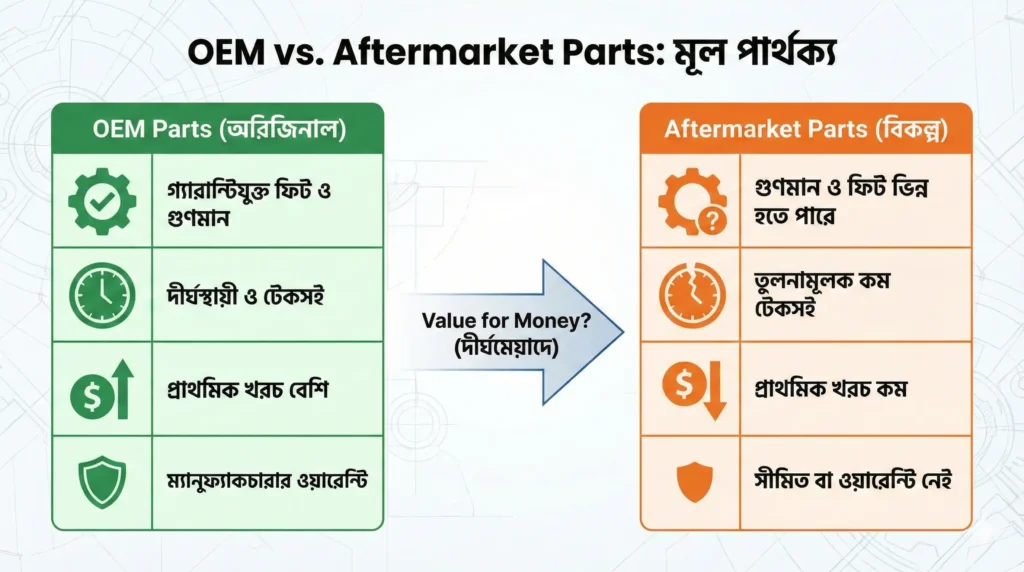
OEM parts cost more upfront because they’re engineered better, manufactured to tighter tolerances, tested more rigorously, and designed to work perfectly with your specific vehicle. They last longer, perform better, and protect your investment.
Making the Smart Choice
Next time you’re faced with that parts counter decision, ask yourself these questions:
- Is this a critical safety component? (Always choose OEM for brakes, steering, and suspension)
- How long do I plan to keep this vehicle? (Longer ownership period = OEM makes more financial sense)
- What are the total costs, including potential additional labor? (Factor in longevity, not just sticker price)
- What does the warranty actually cover? (Read the fine print on consequential damage)
The math is simple when you run the real numbers. That $89 OEM part that lasts 60,000 miles costs less per mile than the $35 aftermarket part that lasts 25,000 miles. Add in the extra labor for early replacement, the risk of consequential damage, and the impact on resale value, and OEM parts emerge as the clear winner for most situations.
Your car was engineered as a complete system. Maintaining it with genuine parts keeps that system operating as intended. It’s not about being wasteful or falling for marketing hype—it’s about understanding that precision engineering requires precision replacement parts.
Choose wisely. Your future self will thank you.
1 Comment
Comments are closed.